Saturday, March 27, 2010

Clean Up Your Act!

Santa Clara, California has had a tradition for the past 50 years of "Clean Up Week". It's basically a month stretching from March to April when residents can put anything they don't want in front of their house to be taken to the dump. I should say, residents can put out anything they don't want EXCEPT for hazardous waste or live ammunition, which is unfortunate, because as a second hand scrounger, I sometimes wonder what to get for the person who has everything.

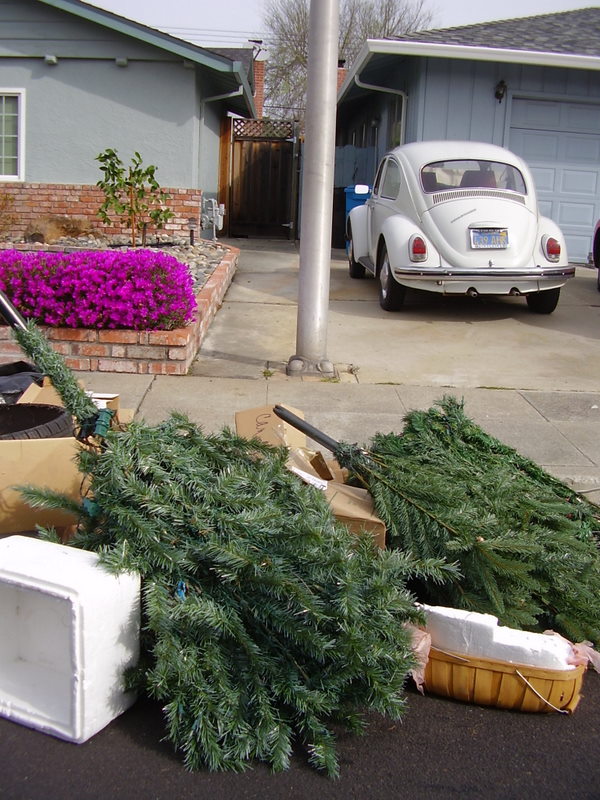
Having a sister that lives in Santa Clara means that I have witnessed clean up week in all it's glory. And by glory, I mean I have cruised around her neighborhood looking for gems in piles of broken furniture, construction refuse, clothing, kid toys, old food, tree trimmings, etc. And boy, have I seen some amazing items. Last year I scored some 1970s vintage Tupperware (fire orange with the ribbed lid that actually burps) and my RockSteady found an awesome cycling jersey with a cow on it, cycling and smart wool socks, and part of a Yakima bike rack. Along with that awesomeness, people last year seemed to be all about dumping off their obsolete metal Christmas tree stands. Who needs a metal stand when you've moved on to a fake tree?  This year I hoped to see similar visions of tree stands, and I brought my camera with the intention of sculpting the tree stands into the shape of a Christmas tree to use as my 2010 holiday greeting. But alas, everyone seemed to have dumped their stands last year. The closest I got was a fake Christmas tree in strewn pieces. What I found this year were toilets. Hundreds and hundreds of toilets. Apparently I missed the great crapper revolution of 2009 that had everyone ousting their old porcelain for something new. Since the flush toilet exterior design hasn't really changed for the past 100 years making it doubtful that the "look" of the toilet was wrecking the overall bathroom aesthetic, I wonder the reason why these poor thrones were discarded to the curb? Was everyone making the move to water saving toilets at the same time?  (Sidenote: when I was researching the history of the modern toilet, I found this.)

As usual I was amazed by what people were getting rid of. How do these Santa Clarans have so much stuff? Even houses that had huge piles in front of them last year, had big piles this year! I'm sure this isn't limited to Santa Clara. It's all a reflection of our consumer driven disposable lifestyle where we can use what we want and discard it to a little bin that is put out once a week and then taken away for us never to be bothered with again. Luckily, I can happily report that all of the Clean Up Week stuff does not end up in the landfill. There are various people driving around the city all month looking for anything thing that could be partially reused. I saw trucks carrying ovens, refrigerators, kitchen tables, desk chairs, dog kennels, fencing, unused lumber and a whole mess of other things. Several computer recycling firms scour the neighborhoods looking for computers to recycle (they get a rebate from the government) so I'm pretty confident that few electronics make it into the garbage system. My bro-in-law put out some bark chips from under a soon to be disassembled play set and people came and scooped it up to use in their yards. A successful reuse scenario! While on a bike ride I saw a women blissfully loading a slightly worn, but still beautiful desk and dresser (1930s era) into her car with the blessing of the man who had just set it on the curb. My friend Caitlin and I noticed some fresh clippings from a fruit tree and we collected about 10 pounds of amazingly fragrant lemons while the owner encouraged us to take more. If I had a car with me, I could have loaded up some great wooden furniture that I'd probably have for the rest of my life.

The main beef that a few neighbors seem to have with the idea of Clean Up Week is that sometimes their piles get scattered as people search for "treasures". This potential scenario leads my sister's neighbor to spray his pile with water from the hose, which is a total asshole move! If he's so worried about people rooting through sensitive paperwork, maybe it shouldn't be on the curb. And really, the only scattering I saw done was by kids (including the said neighbor's sons) who wanted to root through their neighbors stuff and jump on the mattresses and assorted couches on the curb. I saw a group of young boys kick around a Buddha garden sculpture until it's head fell off. Well boys, I hope you get an introduction to my friend karma real soon.

What treasures did I bring back, you ask? Lemons and avocados scrounged from the trees lining my sister's house and a soft bicycle case for hauling a bike on an airplane to pass along to the RockSteady for upcoming races. I contemplated a plastic storage container large enough to hold a pie, but then I remembered that it's easier for me to attach a square box to my bike rack instead of a round container. It was a good reminder to use my logic to to tell myself that I don't need something just because it is free!
                                                                                      
 When life gives you freshly trimmed lemon branches, make lemonade!

Sunday, March 21, 2010

Choices! Choices! Choices!

This week I was perusing the Chronicle of Higher Education and came across an article about the psychology behind choice. Sheena Iyengar, a social psychologist who teaches in the business department at Columbia has just come out with a book called The Art of Choosing, in which she breaks down the reasons why, and how, our brains make choice. Iyengar made a name for herself in the social psychology field due to something called the Jam Study, in which she set up a tasting station in a grocery store that switched between offering customers half a dozen and two dozen samples of jam. While the display with 24 jams attracted more customers, the display with only six options resulted in more sales. The hypothesis is that too many choices deter people from making a decision. It was not the first time that the idea of too many choices were examined by psychologists - in the 1950s, a psychologist named George A. Miller identified that the human brain can really only handle around seven bits of information at a time. Some of the most interesting findings indicate that while people crave choice, they are overwhelmed to the point of inaction when they are faced with more than a fistful of options.

Popular cultural inundates people with choices. It's the consumer drive of America! I can only assume that the desire for more choices over the past 50 years was tied to the Cold War and the assumption that only Communist nations would limit product options for its citizens, so the U.S. had to overcompensate. Well comrades, I am going to admit to feeling a little overwhelmed by options. Have you purchased toothpaste lately? How many versions of whitening/tarter control/fresh-cool-winter mint/cavity protection does a person really need? For those of you that love the options, tell me the last time you played the toothpaste field! Last month? Last year? Several years ago? And do you alternate between paste and gel, or brands? My guess is that you have found a toothpaste you like and you pretty much buy that toothpaste each time. I happen to be a paste fan. Gel makes me feel like I'm brushing my teeth with candy. And I purchase the same brand of toothpaste each time, not so much because I love the brand, but because it was what I grew up using and it works just fine. By automatically setting myself up to look for that brand and style, I don't have to stand and contemplate my toothpaste needs in the store aisle. I've provided myself with limited options to help me through the selection process.  I bet many of you have done the same. I don't really consider myself to be brand loyal to my toothpaste. Instead I'm loyal to the idea of quick decision making. Sidenote: I am not a Crest Kid.

Now, as a white American woman, born in a middle class household, I've grown up with options in almost every aspect of my life, from where I wanted to go to school to where I wanted to live. While we like to assume that everyone in America has a "right" to choice, the truth is that these options are a privilege that is unavailable to many people in this country due to their lack of consumer power. Options are only important if you've got the money to make the choice known. I wonder how some of these studies take into consideration the fact that many people have yet to even be in a position to have more than a handful of options?  In other words, why sample jam if you've got no bread to put it on?

Friday, March 12, 2010

Trash the dress? What the F**K?

My friend Leanne showed me some wedding photos that a friend posted online. They were "Trash The Dress" photos, a series of post wedding photos in which the bride wears her wedding dress while participating in messy activities with the goal of wrecking the dress for future use. I had never heard of such a thing, but apparently it is getting very popular. Post wedding, brides will wear their dress mountain biking, wading in the ocean, playing in mud puddles, walking through garbage dumps, painting like Jackson Pollock or posing in abandoned buildings. Apparently, the photos taken during Trash the Dress sessions look artistic. If you say so.

If you check out the Wikipedia link to the title of my post, you'll read the closing sentences used to describe the meaning behind "Trash the Dress":

It may be done as an additional shoot after the wedding, almost as a declaration that the wedding is done and the dress will not be used again. It is seen as an alternative to storing the dress away, never to be seen again.

 Is this how you want to remember your big day? Maybe if you are marrying Satan.

Hmmmm. Dare I suggest a better alternative? This is about the most wasteful thing you could do with a wedding dress. And wedding dresses cost a lot of dough. Even people that I normally consider rational beings somehow manage to shell out close to a grand for a wedding dress. Society seems to dictate that the norm is to break the bank for a dress to go along with the wedding ceremony and reception. And really, I have no beef if people want to spend that kind of money on a dress - I just wish they would consider alternatives to using it once and trashing it. To me, setting your dress up to be disposable is a strong indicator about how you feel about the rest of your marriage.

A surprising amount of resources go into wedding dresses. They take yards and yards of fabric. How much fabric? Well that depends on the dress. All I know is that I used a little over two yards of cotton fabric to make a kitchen apron. And wedding dresses are usually way more complex than aprons. Common wedding dress fabrics include silk, lace, satin, brocade, organza, velvet, etc. Some of these fabrics, like silk and lace, can be very labor intensive to process. The common synthetic fabrics often are manufactured using toxic chemicals which pollute the environment and endanger the lives of the poor workers around the world that make them. Let's not forget about thread, beading, embroidery, crystals, feathers and all other sorts of decorative accents that are common to most dresses. Whether your dress was made in a sweat shop in Asia, or by a seamstress in your home town, it probably took a lot of time and sewing skills to create.

If you stop and think about the resources and money that went into your wedding dress, why would you ever want to trash it? Like lots of other wasteful habits, I think there is a pretty strong link to conspicuous consumption. Brides buy very expensive dresses to indicate their excitement for their marriage and the importance of their wedding ceremony to others, just like a big ol' diamond ring indicates the grooms love for his bride when it is sparkling on her finger for the world to see. An expensive dress proves that brides have the financial resources to fund such an extravagant purchase. Some may argue that a wedding dress is not an extravagance, it's a necessity. But when your wedding dress purchase could fund half a years rent for many people, or a years worth of food, it seems a bit over the top. And then, if you take your expensive dress and destroy it after one use, you're telling the rest of the world that you have enough money and power to make what ever you want into a disposable item. I still notice that many wedding announcements in newspapers feature detailed descriptions of the wedding dress, including the designer and fabric and a photo of the happy couple. This emphasis on the dress and other parts of the ceremony and honeymoon (another indicator of apparent access to resources) just plays into the American fixation on consumption and who has what.

So what do you do when you've got an expensive wedding dress hanging in your closet? Well, the first alternative is to rent your dress instead of buy it in the first place. My good friend "Rasta P" is getting hitched this summer and she decided to rent a dress. She got to go try on dresses at a rental shop, and once she chose her dress, it was fitted to her and reserved for her use until her wedding day in August. After the wedding, the dress will be cleaned and put back into rotation for use by another bride. The rental of her dress is going to cost a few hundred dollars. She isn't phased by the idea of not having the dress in her closet for the rest of her life. Another friend of mine purchased her wedding dress with the idea that she would have it altered after the wedding into a cocktail dress. She was strategic in choosing a style of dress that would be alterable - she chose a strapless long column dress that could be hemmed at the knee after the wedding. Smart move!

I think people need to get more creative when thinking about uses for wedding dresses beyond trashing them for some seemingly cool looking photographs. The sentimental folks could use the fabric for other things like quilts, or remove the beading and make jewelry to wear and hand down to relatives or friends. Make a fancy outfit for that first puppy. Or baby. The non-sentimental folks seem like they'd have all sorts of cool ways to see their dress used again. Donate it to Brides Against Breast Cancer and let the dress be sold  to help fund the final wishes of people with terminal breast cancer. Check out the I Do Foundation to donate not just your dress, but your left over reception food to local charities. Contact local theater troops and donate your dress to their costume department. Let your best friend or relative use the dress for their own wedding. There are so many options for dress reuse or recycling that don't involve destroying the dress for the sake of destroying it. Besides, Trash the Dress photos might seem bold and artistic, but do you know what is more cutting edge? Nudity.

Friday, March 5, 2010

Climbing Toward Consumption?

This morning my gent pointed out a newly arrived Patagonia catalog lying on his kitchen table. Patagonia decided to use old photos of rock climbers from 1970s California throughout the catalog to give it a sort of nostalgic feel. The photos are quite striking and taken from a new Patagonia book The Stone Masters: California Rock Climbers in the Seventies.

Interestingly, what I found even more striking about the catalog was that the climbers photographed do not appear to be wearing any type of special climbing clothing. Sure, they've got climbing boots on, but the shirts, tank tops and pants appear to be cotton. Maybe a cotton/poly blend for some of them. No climber, male or female, is wearing any cloth that looks like it was created by scientists. None of it would feature a descriptor of "dri fit", "nano", "technical", "wicking performance" or "appropriate for high-output activities". Instead, the 70s climbers look like they one day decided to bid suburbia adios while wearing jeans, a Hanes t-shirt and an old flannel, and hit the road carrying a knapsack containing a sandwich and an extra pair of tighty whiteys. I find it interesting that when reading the bios of the climbers, they never mention how any sort of specialized clothing made a difference in their ability to conquer new routes. What's ironic is that a lot of them speak about being broke! I doubt any of them could have bought the $75 rock climbing t-shirts and shorts that Patagonia advertises in the catalog. If anything, seeing how these climbers operated just a few decades ago made me even less interested in acquiring more specialized gear. They were focused on becoming stronger and smarter climbers. I wonder what it is that makes people think they need certain items to be good at anything? Even if you've got the best gear, at some point you've got to prove that you know what you're doing. Your $150 hoodie isn't going to be able to coach you around that crack.

In general, I find most clothing highly amusing. What people decide to wear is very telling, especially when they wear a certain brand, or have a logo or message on their clothing or accessories. Toward the back of the Patagonia catalog was a $25 baseball cap featuring the words "Live Simply" and an embroidered acoustic guitar. I found this to be hilarious! Call me a doubter, but I don't envision anyone who is committed to simple living spending over two bucks, let alone twenty, to purchase a new baseball cap that advertises their simple living philosophies. But perhaps I am putting too much stock into the hats. Maybe Patagonia thinks that just getting the message out there will inspire people. Will anyone see that message and think, "oh man, I really need to start living simply. That's it. I'm getting rid of my cars, replacing my lawn with native plants and giving up foods that came from more than 100 miles away"? I honestly don't know.

For a large company, Patagonia does some pretty cool things so I don't really want to bash it. I've got some toasty warm Patagonia long underwear that I bought three years ago and will probably have for the rest of my life. It's a company that has a strong history with rock climbing, and a solid mission of environmental protection which is put into practice through their efforts to use recycled fibers and also allow customers to recycle their products back to them. In the late 1990s they moved to use only organic cotton in their products. Their belief in Corporate Social Responsibility also sets them apart and is a good model to be used by other corporations. However, can any corporation really be considered "responsible" if they are driven by the desire to get people to consume their products? Is the true nature of business (to make a profit) compatible with respect for the environment and human kind, things that I deem necessary to show responsibility? Maybe? Is it different for companies that create food for consumption instead of non-edible goods? I need to do some more thinking!

Thursday, February 25, 2010

Bummer - Like Nothing Else

I read an article in the New York Times today about the demise of the Hummer. General Motors tried to off load the company to China, but the Chinese government apparently felt that Hummers do not represent the auto manufacturing goals of the country. Apparently the Chinese government is all hot to manufacture cheap, small, fuel efficient cars for purchase in country and for export (who knew that would be popular?!?!?). And this means that Hummer is going to die. Well, let me be the first in line to strike a nail into that coffin.

I think that Hummers are fine for combat zones. There it makes sense to be protected by a sturdy frame, built to withstand heavy fire. But the Hummer for civilian use has always seemed like pure ridiculousness. I've heard Hummer owners state that they like driving something so large. I once read a magazine interview in which a 65 year old woman said that she felt safer driving a Hummer because it was bigger than everything else. Um, ok. Did you check out the early 90s Cadillac that gets 15 mpg better fuel efficiency, and sits low enough that you could potentially still pull yourself into the driver seat in five years? Those Caddies are freaking boats! Have you considered that if you happen to cause an accident, you'll probably wipe out the family of four who was unlucky enough to be in a collision with a several ton Hummer? Probably not.

Sturdiness and Safety are just excuses for conspicuous consumption. Hummers are expensive and the general public knows this. Gas to fuel the Hummer is also very expensive, so not only can you show off the fact that you drive an expensive car and have the funds to do so, you can also thumb your nose in the face of the environment with your piss poor excuse for a luxury SUV. Aren't you special.

The Hummer website states that,

"
HUMMER's trucks, 4X4 vehicles and luxury SUVs combine off-road capabilities and interior comfort, creating the ultimate in rugged sophistication."

I want to know exactly who these people are who need "rugged sophistication". I've never noticed a Hummer anywhere close to a place that could be described as "rugged", unless there's a portion of Malibu that I don't know about. The incredibly bright Crayola inspired colors of the H2 and H3 models rarely feature the mud, dirt or any other evidence of off-roading outside of Hummer advertisements. Maybe I need to venture outside of the west coast and look for the rugged sophisticates who apparently populate Colorado, Utah and Wyoming and have their mud spattered vehicles hiding in the mountains and canyons.

As for "sophistication", I don't even know where to start. Sophistication is defined by Miriam-Webster online as:

1 a
: the use of sophistry : sophistic reasoning b : sophism, quibble
2 : the process or result of becoming cultured, knowledgeable, or disillusioned; especially :cultivation, urbanity
3 : the process or result of becoming more complex, developed, or subtle


If there is one thing the Hummer is not, it's subtle.

Perhaps Hummer purchasers think they are showing their complexity and advanced development when they drive their gargantuan beast of a car. Maybe I've misunderstood Maslow's hierarchy of need all these years and when you reach esteem, you go ahead and fork over some serious dough for a car that can help you get to the top (self actualization) and on the way tells the world you've made it!

For some odd reason, I don't seem to equate Hummers or their drivers with culture or knowledge. Apologies to all those rugged sophisticates in the world. Seems to me that any rational person would read the Hummer fact sheet and do a bit of critical thinking (we could even call it "knowledge increasing") about all the things associated with their purchase. A few things seem like they would immediately come to mind, like sticker price, natural resources used to create a car of that size and weight, amount of fuel used and where fuel comes from, and price of that same fuel and the necessity for owning a car that could withstand warfare in American suburbia. Where is the logic?

I'm sure that Hummer owners probably love their cars. I know few people that don't love what ever they've decided to fork over such a huge amount of money to buy, although I suppose some Toyota owners might challenge me on that right now. I can't help but wonder if Hummer owners would have just as much love for any other make and model of car that is entertaining to drive. Let me suggest a mini cooper (used of course) - fun to drive, not a gas hog and attractive. Quite small, but if you've managed avoiding collisions in a Hummer, you'll probably be just as good of a driver in a different car.

When my niece Lexi was about five, she looked out her car window and upon seeing an H2 said, "That's not a Hummer, that's a bummer". Well Lexi, it looks like there will be a few less bummers on the road in the years to come. And I for one, couldn't be happier.

Friday, February 19, 2010

Making Yogi Proud

I was thinking the other day about how my project would be a lot harder if I didn't live in Corvallis. It's a city that is compact enough that I can get around on bicycle and close enough to farm land and forest that my scenery can change the more I'm willing to pedal. I've got many options for grocery shopping at large chain stores, smaller specialty food shops (my latest love is Rice N' Spice) and an amazing co-op with locations on both sides of town. There are about five second hand shops from Goodwill to Habitat for Humanity, two beautifully run women's consignment shops, used book and music stores and multiple antique boutiques so I still feel like there is enough variety for me to fulfill any sort of consumer desire that could arise.

In early January I popped into OSU Folk Club Thrift Shop, a little second hand shop in downtown Corvallis whose proceeds fund scholarships for OSU students and grants for local non-profit organizations. I was there on a quest to find some cast iron frying pans to supplement my households pans and move us away from bizarro Teflon. The cast iron goods were non- existent that day, but on my second spin around the store (I always take two trips), I noticed a nicely shaped one foot square, eight inch deep picnic basket with a wooden lid. I've been in the market for a picnic basket since last summer. The basket was in good condition, and I picked it up and thought, "This would be perfect to fit on my bike rack!" The only issue for me was the late 70s era floral tole painting on the lid in the dated shades of brown, rust and olive green but it seemed easy to replace with a different painting or collage so I bought it for a cool five bucks and brought it home.

When I got the basket home and really thought about what I would want on a picnic basket I kept coming back to an outdoor scene, something with mountains. Unfortunately, I'm not the most experienced landscape painter and I knew that anything I attempted would end up looking like a kindergarten finger painting exposition. Lucky for me, my mom is an awesome wilderness painter! I brought her the basket on one of my visits home and a few weeks later she returned the basket to me with a lovely painting of a mountain range with a field of purple lupin in the foreground. But that is just the outside! On the inside of the lid she painted a beach scene. That picnic basket transformed from being a nice thrift store find to a piece of art! I can't wait to strap it to the back of my bike and go out for some adventures.

The picnic basket re-vamp was a good reminder for me to look for the potential in the things I notice at second hand shops and the stuff I already own. What can I alter and improve to better meet my needs? What can be made beautiful?

Friday, February 12, 2010

Not Buying It: My Year Without Shopping

When I started my project, my friend Emily asked if I'd read Not Buying It: My Year Without Shopping by Judith Levine. I hadn't, and promptly requested it from the library. I was pretty excited when it arrived a week later and I could jump into another person's account of changing their buying habits for a year to help me stay motivated through the first month of my challenge!

Judith Levine and her partner Paul spent 2004 attempting to buy nothing except for food - and the food they purchased had to be as unprocessed as possible. They were both self employed, she as a writer and he as some sort of consultant, and in their mid 50s when undertaking their challenge. While I found a lot of our motivations for undertaking our projects to be similar (wanting to consume less, re-evaluating the need for "new" items, feeling overwhelmed by a culture that rewards buying) the way that she and her partner view their consumption and negotiated 'necessities" is quite different than my thought process.

The author owns a rent controlled apartment in New York City, where she and her partner spend Spring and Fall. Her partner, Paul, owns a small farm house on numerous acres in Hardwick, Vermont where they spend Summer and Winter. Together they own 3 cars. A Honda Civic for the city, a Subaru to get around Vermont in the winter and an old Chevy pickup to use for hauling and yard work in Vermont. To me, the idea of having two homes and three cars for two people seems kind of extravagant when in the next breath the author talks about simplifying life. In the first chapter, Levine talks about the amount of sheer stuff she and her partner have accumulated - so much stuff that they decide that the Vermont house should be remodeled to accommodate their things! She blatantly states that her partner is a pack rat and refuses to get rid of anything. Way to pass the buck, Judith. It was bizarre to imagine a couple "not buying it" while at the same time knowing that they were buying the raw goods to build a house and services of a contractor to do the work. Later in the book there is mention of their three hour Vermont drive to salvage an old claw foot tub from a collapsed barn, but no where else is there any talk about using eco-materials or recycled building supplies, which seems really odd.

While the contradictory elements of this book, like the house remodel, made me exclaim, "WHAAAAAAAAAATTTTTTTT?????" a few times, it definitely brings up some good points. In NYC, Judith and Paul are able to re-acclimate themselves with all the free entertainment that is available on a daily basis. They go to open mic nights, free concerts in parks and at churches, and spend more time out for walks just for the sake or walking, instead of walking on their way to buy items. While the level of performances they hear is lower than the professional performances they are used to, the speak of the fact that it is reinvigorating to be around people who show such spirit in their amateur work. In Vermont, Judith thinks she has lost her SmartWool socks and has a panic attack, and then goes on to explain how people get sucked into brand loyalty! An affinity for certain brands even has a name, "a lovemark" which is loyalty beyond reason. Another result of the author's project is the fact that she became much more politically informed and involved. Given that she cannot buy books, she starts frequenting libraries all over the boroughs of New York and is shocked by their run down states and minuscule budgets. As it is an election year, Judith uses the time that she would have previously spent shopping, browsing or price comparing online and volunteers for her chosen candidates. As this was a huge election year (Bush vs. Kerry), much of the latter third of the book surrounds the idea of moving from being an American consumer to an involved American citizen.

Perhaps the best take away from this book is the description of what happens when you are in a position of not buying things. When you tell your friends, or even strangers, their response is generally to feel bad and then want to buy something for you because they assume your life is really, really hard! Once the author's friends hear about her project, they call her to offer tickets to performances or sporting events that they cannot use. They meet for walks, but then the friends often offer to treat her to a glass or wine, or a movie. It really all comes down to power - people who consume and have the money to buy things, have power in our society. It's the main way we make our decisions - "Put your money where your mouth is". In relationships, the author's friends feel very awkward that they have the power to buy, while Judith does not, and they try to level things buy purchasing treats for her!

Of course, their is another side to this power struggle. It's the discomfort of telling people that you need their help. Will they think you're incompetent since you don't understand how to maneuver our "no free rides" society? The author speaks about heading out to ski one day and realizing that she has forgotten her ski wax and is carrying no cash! She is completely worried about stopping in the ski shop to ask if she could borrow some and has practiced her speech about not buying things for a year, and how she usually carries her own wax, etc. Surprise, surprise, when the ski shop guy not only says that she can use wax, but actually gives her the wax to keep with a genuine smile. While we can all hem and haw about the fact that people should be competent enough to take care of themselves, when it comes down to it, most individuals will offer help to other individuals.

Over the last 6 weeks of my own quest to buy nothing new, I've found people to not just be supportive, but to actively want to help in my pursuit. After reading about my fascination with lightning jars, my colleague Mary sent me an email saying that she had a few lightning jars she was going to take to Goodwill, and would I want them? Yes please! Another friend, seeing a Facebook note I put out asking if anyone knew where I could find used cycling shoes, sent me an email saying she had a slightly used pair I could have for ten bucks. Yee ha! It can be hard to put yourself in a place where you have to ask people if they can help respond to your needs. You have to trust that your acquaintances, colleagues, friends and family know you well enough to realize that you aren't a mooch (This is not going to work if you actually are a mooch - reciprocation is the key.) There is also the fact that it is so much faster just to go out and buy what you need, all shiny and new. Not buying new means that I have to either plan very far in advance, or not have a strict time line for shopping. I am a person who carries high expectations for myself, and I am quite a choosy shopper. Buying used means that I have to regularly adjust my expectations for how things I need will look. Are the used cycling shoes I acquired the most beautiful shoes I've ever seen? No. I probably wouldn't have chosen the style in a million years. But they serve their purpose beautifully, and when I'm on my bicycle enjoying a February sun break, the furthest thing from my mind is what my shoes look like. I'm just happy to be outside and get to utilize my bike to its fullest.